
Workplace Chemical Management
Know what's on your shelves, what it can do to your team, and how you're controlling it.

The riskiest chemical on your site might be in an unlabelled spray bottle.
Most chemical incidents don’t start with a drum of something exotic. They start with cleaner decanted into a drink bottle, a safety data sheet from 2014, or acid stored next to chlorine because that’s where the shelf space was.
Chemicals also hurt people slowly. Dermatitis, asthma and long-term exposure illnesses can show up years later, long after anyone could fix the cause.
What the Hazardous Chemicals Rules Ask of You
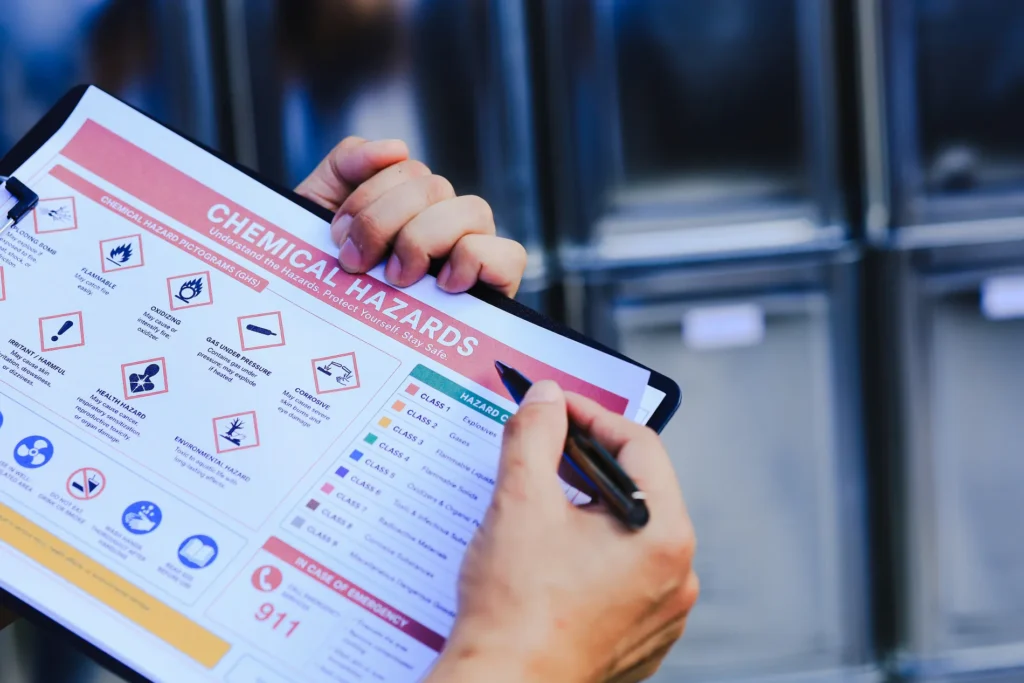
If your workplace uses, handles or stores hazardous chemicals, the WHS Regulations (and Victoria’s OHS Regulations) expect you to:
- If your workplace uses, handles or stores hazardous chemicals, the WHS Regulations (and Victoria's OHS Regulations) expect you to:
- Keep a register of hazardous chemicals, with a current safety data sheet (SDS) for each one
- Label every container correctly, including the ones your team decants into
- Manage the risk of each chemical, store incompatible chemicals apart, and meet manifest and placard rules once quantities pass set thresholds
Keep airborne contaminants below the workplace exposure limits, and provide health monitoring where certain listed chemicals are used
Could You Pass a Chemical Inspection Tomorrow?
Could you hand an inspector a current register and SDS for every chemical on site?
Are chemicals being decanted into containers with no label?
Has anyone checked your exposure levels against the new workplace exposure limits?
If the honest answer is "probably not", you're not alone, and it's fixable.
Start with what's on your shelves.
Chemical Management That Starts at the Shelf
We start with a physical stocktake, not a desktop review. If it's on site, it goes on the register.
Our chemical management service will:
- Build or clean up your hazardous chemicals register, with a current SDS for every product
- Review storage, segregation, labelling and spill controls against each SDS and the Australian Standards that apply
- Complete chemical risk assessments, starting with whether a safer product or process can replace the hazardous one
What Substitution Looks Like
For example, a food plant uses a strong caustic cleaner for daily wash-downs because it always has. A proper risk assessment asks whether a lower-hazard product would do the job at that soil load, or whether a closed dosing system could replace hand decanting. Either change removes the risk at its source. No amount of gloves and goggles can do that.
You get a chemical system your team can follow and an inspector can check in minutes.
Getting Your Chemicals Under Control
We start on the shop floor and finish with a system your team can run without us. Our Assess, Align, Assure method takes you from a stocktake of what's on site to a register, storage and controls that stay current.

ASSESS
every chemical on your site
ALIGN
your register, storage and controls with the regulations
ASSURE
your chemical system stays current
Chemical Safety Experience From Gases to Food Production
Rob McDonald managed safety, training and compliance at BOC's South Pacific National Distribution Centre and was SHEQ NSW Major Hazard Facility Advisor for BOC Australia. He then led group safety and environment at Freedom Foods Group. That's hands-on experience with compressed gases, dangerous goods and food-plant cleaning chemicals in live operations.
Backed by Real Operating Experience



What Site Managers Ask About
Workplace Chemical Management
What is a hazardous chemicals register?
A hazardous chemicals register is a list of every hazardous chemical used, handled or stored at a workplace, with the current safety data sheet for each. Under the WHS Regulations it must be kept up to date and be easy for workers to access.
How old can a safety data sheet be?
An SDS should be no more than five years old. Manufacturers and importers must review and reissue their SDS at least every five years, and your workplace should hold the current version for every product on the register.
What are workplace exposure limits (WELs)?
Workplace exposure limits are the maximum airborne concentrations of a chemical a worker can be exposed to. They replace workplace exposure standards in Australia from 1 December 2026, and some limits are lower than before.
When does a workplace need a manifest and placards?
A manifest and placards are required when hazardous chemicals stored on site exceed the quantities set in the WHS Regulations. Once you pass manifest quantities, you must also notify your state regulator. A chemical audit will show whether you’re over the thresholds.
Does GSD Safety provide chemical handling training?
Yes. GSD Safety runs practical, instructor-led chemical management training built around the chemicals and tasks at your site. The training is non-accredited, as GSD Safety isn’t a registered training organisation.